All Posts Tagged With: "Abraham Lincoln"
Lincoln, the Antiwar Congressman
The only time before his presidency when Abraham Lincoln held national office was a single term (1847-49) in the U.S. House of Representatives. During that time, while debating the Mexican-American War, Lincoln zealously defended the constitutional prerogative of Congress to declare war and enact legislation against a perceived usurpation of these powers by the executive branch. Between December 22, 1847, and July 27, 1848, in speeches on the House floor and in his personal letters, Lincoln argued against the right of any president to initiate a war. There are no better arguments against President Lincoln’s unconstitutional war of 1861 than his own.
Lincoln Follies
A few of us now decrepit pre-Reagan “conservatives” can remember the brief flicker of hope of saving the republic that we had around 1980. Around about that time we were heartened by the founding of the Washington Times, which, it was thought, might become an effective foe of the mainstream media—despite its connection with the vile Moonie cult. Like everything else in the spurious “Reagan Revolution,” the Times was soon just another firing post of the disguised (but non-spurious) Trotskyite revolution of neoconservatism.
Rendering Unto Lincoln
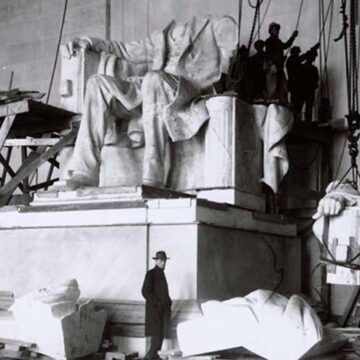
“Now he belongs to the ages,” Edwin Stanton is supposed to have said, when he learned of President Lincoln’s death. In a trivial sense at least, Stanton was obviously correct. We have Lincoln’s face on the five-dollar bill—a bill that used to be worth more than a Happy Meal, before Lincoln’s disciples degraded the currency—and his grandiose monument in Washington, with a grotesque statue by the Transcendentalist sculptor-politician Daniel Chester French.
Mr. Lincoln’s War: An Irrepressible Conflict?
“[T]he contest is really for empire on the side of the North, and for independence on that of the South, and in this respect we recognize an exact analogy between the North and the Government of George III, and the South and the Thirteen Revolted Provinces. These opinions…are the general opinions of the English nation.”
—London Times, November 7, 1861
“The preservation of the union is the supreme law.”
—Andrew Jackson, December 25, 1832
The Civil War was the greatest tragedy ever to befall the nation.
The Treasury of Counterfeit Virtue
“O wad some Pow’r the giftie gie us
To see oursels as others see us!”
—Robert Burns
A few years ago, a well-known conservative historian lamented that the American public was not morally engaged to undergo sacrifice after the September 11 attacks, unlike it was in its heroic response to Fort Sumter and Pearl Harbor.
Wait a minute.
Obama as Lincoln: Mask and Mirror
Ron English, the self-styled “Robin Hood of Madison Avenue” who specializes in “liberating” commercial billboards and defacing them (albeit artistically) with his anticapitalist messages, has painted a portrait of Obama as Lincoln: The President’s thick lips, crinkled brow, and eyes sparkling with a preternatural intelligence are seamlessly merged with the high forehead, biblical beard, and absurd ears of the Great Emancipator.
Lincoln and God
Before the first shots were fired in the U.S. Civil War, President Abraham Lincoln had begun to style himself as an instrument of the Lord. But as William H. Herndon, a law partner and Lincoln biographer, wrote, “[t]he very idea that he was in the hands of an invisible, irresistible, and inevitable deaf power which moved as an omnipotent force evidently harassed and worried him.”
Shattering Lincoln’s Dream
I just got a copy of a thoughtful new book, Vindicating Lincoln: Defending the Politics of Our Greatest President, by Thomas L. Krannawitter. The book mentions me a couple of times, in polite disagreement. Krannawitter, now of Hillsdale College, is a disciple of Claremont McKenna College’s Harry V. Jaffa, as I once was.
It Can’t Be Repeated Too Often (Until It Sinks In)
The purpose of Political Correctness is to suppress true ideas. Its proponents have no interest in suppressing falsehood.
You cannot have a First World economy and military with a Third World population.
The Republican Party is not and never has been a conservative party. (For most of American history, until less than a century ago, the Democratic Party was the conservative party.)
Lincolnism Today: The Long Marriage of Centralized Power and Concentrated Wealth
In the Anglo-American experience, the partisans of concentrated wealth and advocates for political centralization have long been connected. Over the last three centuries, that connection has grown stronger, and in the United States this process accelerated dramatically during and after the Lincoln administration. Lincolnism, the idea that the central state can and should use its coercive apparatus to serve the narrow interests of an economic elite at the expense of the commonwealth, prevailed decisively in the War of Secession and during the decades that followed, with high tariffs, railroad subsidies, and the apportionment of public lands.