About the Author

Tom Piatak is a contributing editor to Chronicles: A Magazine of American Culture. He writes from Cleveland, Ohio.

See All Posts by This Author

The Forgotten Ideology

by Tom Piatak

[Subscribe online to Chronicles: A Magazine of American Culture. Click here for details].

“Socialism will bring in an efflorescence of morality, civilization, and science such as has never been seen in the history of the world.” —Ferdinand Lassalle

Modern American conservatism has been marked by a fascination with ideology. Despite arguments that conservatism is not an ideology or is opposed to all ideology, American conservatives have regularly attempted to systematize their own beliefs. Moreover, they have often attempted to define themselves by reference to ideologies they oppose. Opposition to Soviet communism played a major role in uniting conservatives of many different varieties throughout the Cold War. More recently, neoconservative apparatchiks such as Norman Podhoretz, Victor Davis Hanson, and Christopher Hitchens have sought to portray President George W. Bush’s “War on Terror” as part of a protracted global struggle against “Islamofascism,” and Jonah Goldberg has made a bid to become the conservative movement’s Mikhail Suslov by spending four years writing a book arguing that “fascism” is the intellectual taproot of American liberalism.

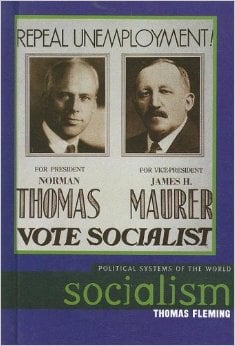
Somewhat overlooked in all of this has been the ideology that has enjoyed the most political success in the modern era: socialism, the object of this enjoyable study by Thomas Fleming.

The reader of a book as brief as this will hardly learn all there is to know about socialism, but he will encounter a thoughtful overview of this important subject, from such forerunners as Plato, Christian millenarians, and Enlightenment philosophes down to the present day. What is more, he will encounter an original thinker and witty writer. Any book that contains such lines as “Rousseau had a very high regard for freedom, especially his own” and “The Fabians may have believed in economic and social equality, but they refused to abandon their belief in the superiority of intellectuals” is well worth the read.

[amazonify]0761426329[/amazonify]Fleming describes Sir William Harcourt’s observation that “We are all socialists now” as “an accurate, if somewhat extreme, description of all the major parties of Europe and the Americas.” Despite the dismal failure of avowedly socialist parties in America, Fleming notes that American socialist Norman Thomas “lived long enough to see most of his socialist policies enacted by Democrats and Republicans.” Citing such facts as the inflation-adjusted 500-percent increase in government spending on education over the last four decades, and the federal government’s ownership of 28 percent of all land in America, Fleming argues that “the United States has developed its own tradition of democratic socialism, but rarely under that name.” Indeed, as Fleming notes, in the United States “socialist parties have always been misleadingly described as ‘liberal.’” The ideology undergirding American liberalism is in fact socialism, not “fascism,” a defunct left-right hybrid that combined “a belief in the nation and its traditions” with domestic policies that were “primarily socialist.” A “belief in the nation and its traditions” is markedly absent from the rhetoric of many American liberals, which is the major reason the Democratic Party has been at a disadvantage in so many recent electoral contests. Indeed, the leading contender (as of this writing) for the Democratic nomination, Barack Obama, has a wife who did not feel pride in America until her husband began winning primaries and a minister who prefers “God damn America” to “God bless America.”

Fleming sees the essence of socialism as egalitarianism—an emphasis on “the duty of society to ensure social and economic fairness and equality.” This is both socialism’s greatest strength and its greatest weakness. It is socialism’s greatest strength because the enduring inequality that is part of the human condition means that “the socialist revolution will never run out of enemies.” The persistence of inequality explains the “protean” nature of socialism and why “there are an almost infinite variety of socialist experiments.” Conversely, human nature means that socialism’s vision will never succeed: “Ever since Plato’s time, socialist theorists have had to wrestle with the fact that human nature may not be up to the demands put on it in an ideal society.” The desire to create the perfect society by eliminating the imperfect led to the greatest blot on the Marxist record, the unequaled mass murder that accompanied communism. But the reality of human nature means that even peaceful socialist experiments will inevitably end in disappointment and failure.

The initial focus of socialism was on economics, and socialism has certainly had a profound impact on economic life around the world. Every major industrialized nation has some form of governmental safety net, and Fleming observes that “some aspects of socialism . . . are probably inevitable in the vast countries and complex economies created by liberals and nationalists over the centuries.” But too much taxation and regulation kills economic initiative, and these days not many socialists are calling for nationalized industry and central planning. As an example of the dead end to which socialist economics leads, Fleming cites Sweden, where in the mid-70’s Ing­mar Bergman was being taxed at a rate of 139 percent. By the 1980’s, inflation in Sweden was twice the European average, growth and productivity were stagnant, and taxes represented 55.3 percent—and government debt, 75 percent—of GNP. Even the enthusiastically socialist Swedes felt the need to cut back on spending and taxes, and by 2005 government debt had dropped to 52 percent of the GNP. Of course, far more dramatic departures from socialism occurred elsewhere, and the “1980s witnessed a virtual free market revolution” with the ascendancy of Reagan, Thatcher, Chirac, and Kohl. The end result has been something of a stalemate, with none of these figures enjoying “major success in slowing, much less reversing, the moral and social revolution that had taken place,” but with their socialist opponents emerging from the 1980’s having accepted the “proposition that the market should be allowed to operate within more or less strict limits.”

If the socialist revolution has arrived at something of an impasse in the economic arena, it has been making great advances on other fronts—in the culture, in the family, and in its war against the nation-state. Fleming rightly sees Antonio Gram­sci, who died in one of Mussolini’s prisons, as “one of the most influential socialist thinkers of the twentieth century,” and the “long march through the institutions” to which he gave birth has been spectacularly successful in turning the culture-forming institutions of the West toward the left. In America, the Gramscian revolution was carried out under the auspices of members of the Frankfurt School such as Max Horkheimer and Theodor Adorno, who fled Hitler to ensconce themselves at the New York School for Social Research. The Frankfurt School was the intellectual wellspring of the New Left of the 1960’s, which has gradually succeeded in undermining traditional morality and habits of thought in the United States.

Cultural leftism hardly began in the 60’s, though. The Marxist left has, from its inception, been hostile to both the family and the nation-state. Engels “saw the traditional family as oppressive,” and “there has been a strong tendency in socialist thinkers . . . to deny legitimacy to the institutions of marriage and family and celebrate sexual freedom.” Gunnar and Alva Myrdal campaigned in the 1930’s for “aggressive sex education for all children” and “legal contraception and abortion to liberate women from childbearing.” The Myrdals’ vision now holds sway throughout the Western world. Marx called “for the end of the nation-state” with the “ultimate goal, already anticipated by the Communist Manifesto, of world government.” Although we are not there yet, NAFTA and GATT have served to undermine American sovereignty, and many of the same forces that helped push us into those supranational compacts are now pushing for a North American Union modeled after the European Union. Interestingly, many of the strongest proponents of NAFTA and GATT were not socialists at all, but classical liberals.

One of the great strengths of Fleming’s book is that it demonstrates that, in spite of the important contributions by such seminal figures as Friedrich Hayek to the critique of socialism, classical liberalism remains an uneven opponent of socialism—and is sometimes even a kindred spirit. Fleming cites German socialist Eduard Bernstein, who

understood that socialism, rather than being in conflict with basic liberal principles, could be seen as an extension of them. Liberals had worked to end restrictions imposed by religion and aristocracy. What remained was to end the oppression based on wealth, and this could only be done by gradual and democratic means.

Those who follow John Stuart Mill’s dictum that “the despotism of custom is everywhere the standing hindrance to human advancement” are, at best, unreliable defenders of such prime targets of cultural Marxism as the family, tradition, and religion. Indeed, hostility to tradition was the animating spirit behind the destructive work of Gramscian Marxists in both America and Europe. And many of those who claim to draw on the classical-liberal tradition, such as the editors of Reason, are unremittingly hostile to traditional morality. Fleming’s critique of classical liberalism extends even to the cornerstone of Austrian economics, the subjective theory of value, which Fleming sees as mistaken because “most individual preferences are determined not by individuals but by families, friends, communities, social fashions, and local and national traditions.”

If classical liberals are unreliable opponents of cultural Marxism, they are full-fledged allies in the Marxist war against the nation-state. Marx and Engels saw free trade as the first step toward the elimination of the nation-state, an insight shared by liberal thinker Frédéric Bastiat, who wrote that free trade would lead to the “peaceful, ecumenical, and indissoluble union of the peoples of the world.” Fleming offers this revealing quote from Hayek to illustrate the classical liberal aversion to national borders:

It is neither necessary nor desirable that national boundaries should mark sharp differences in standards of living, that membership of a national group should entitle [it] to a share of the cake altogether different from that in which members of other groups share.

In practical terms, America is being subjected to free trade and mass immigration, despite the skepticism of the general populace, because the heirs of both Marx and Hayek are in agreement that national borders are artificial and undesirable.

Fleming foresees socialism continuing to expand in new directions. He notes that socialist parties

embraced feminism, sexual freedom, anti-colonialism, and minority rights, and by the end of the last century a typical socialist agenda might include protection of endangered species, same-sex marriage, Third World development, and global government.

Indeed, environmentalism, with its almost unlimited scope for new governmental regulation and control, is likely to be particularly enticing:

Green parties are generally made up of socialists and leftists who added environmentalism to their agenda without giving up their commitment to Marxism. . . . It is very possible that the next generation of socialists will be far more green than red.

Unsurprisingly, Fleming’s overall assessment of socialism is negative. Even the socialists who have avoided mass violence have produced societies “run by meddlesome do-gooders whose interventions in the free market and in private life have produced dullness, sterility, and dependency.” However, he concedes its achievements, including “often soften[ing] the hard lot of those who have failed to succeed in competitive societies.” He credits Marx with seeing “what classical liberals refused to see, that industrial capitalism had undermined all the security enjoyed by poor people in traditional societies.” He also notes that, “If liberal opponents of socialism usually win the arguments about efficiency, they are defeated rather easily on arguments about justice and morality.” Fleming argues that seeking to reduce society to Ludwig von Mises’ dictum “the means by which each individual member seeks to attain its own ends” will have little appeal outside the libertarian echo chamber.

Fleming also suggests that the “dullness, sterility, and dependency” wrought by socialism will be found in any mass society organized along bureaucratic lines, including our own. Fleming’s own sympathies lie with those resisting such a mass society, and he deals with the often overlooked thinkers who sought a Third Way between socialism and unfettered capitalism, who desired

a society made up of small farmers and shopkeepers, where local and regional cultural traditions were preserved and culture was more than a product sent out to radio stations and movie theaters.

Many will contend that any effort to recreate such a society is quixotic, but since the men who secured our independence from Great Britain and wrote our Constitution lived in such a society, it at least seems worth a try.

[Socialism • by Thomas Fleming • Tarrytown, NY: Marshall Cavendish Benchmark; 144 pp., $39.93]

Tom Piatak writes from Cleveland, Ohio.

This article first appeared in the July 2008 issue of Chronicles: A Magazine of American Culture.

[Subscribe online to Chronicles: A Magazine of American Culture. Click here for details].


Comments

There Are 13 Responses So Far. »

  1. An excellent essay/review of Dr. Fleming’s work.

    I for one share distributist sentiments. It will be difficult if not impossible to return to a world of small farms, shops and local cultures of tradition without the (cataclysmic?) dismantling the centralized state-corporate structure. To that end, classical liberals are, for better or worse, brothers in arms. At least Hoppe in his writings has acknowledged something along the line of Dr. Fleming’s argument that, “most individual preferences are determined not by individuals but by families, friends, communities, social fashions, and local and national traditions.”

  2. Tom: Great review. I bought this book at the last JRC meeting, and have read parts of it.

    Tom: “In practical terms, America is being subjected to free trade and mass immigration, despite the skepticism of the general populace, because the heirs of both Marx and Hayek are in agreement that national borders are artificial and undesirable.”

    There seems to be a coalescence of socialism and modern capitalism, in the form of globalism, fostering the same ends: mass Third World immigration, political correctness, free trade (Marx supported free trade), and egalitarianism. Globalism is the dominant paradigm of our age, which, if repeatedly assailed, hopefully will some day fall.

  3. There are some who think such a return is inevitable whether we want it or not (e.g., James Kunstler). Perhaps the end of cheap energy will return us to farm and homestead.

  4. As a life-long socialist, I find this discussion of socialism by it’s ignorant, not necessarily stupid, detractors to be really amazing. Is the understanding of socialism (and Marxism) forever limited to the Rush Limbaughts of the reactionary right? Would you go to the Catholic Church for an understanding of atheism? Any unspecific generalized statement about “socialism” is almost invariably wrong, especially when lumping together Stalinism, Maoism, Hugo Chavez, scandanavian social democracy, with the same idealist brush.

    The philosphical (idealist) study of “socialism” written of, by. and for the
    ruling elites of this world will never reveal the barbarism inflicted upon the vast majority of humanity by capitalism over the last 500 years up to and including the present “New American Century”/

    What would you call the Bush/Cheney regime? Almost every conservative and reactionary laments “Get government off our back! But corporate capitalism now has essentially privatized (i.e. owns) the federal governmentl
    Thus we will never see an end to global wars for profit, never a serious attempt to end global warming. Mass migrations (i.e. impoverished Mexican working people into U.S.) are most recently caused by NAFTA treaties that drive peasant farmers off the land into the U.S.

    Public health care, public education, any function of government for the common good (commonwealth) are forever under attack by privatizers wanting to make a fast buck. In the long term, ending public services means ending taxes to support these services. No matter if it turns the U.S. into a third world country — mass poverty to profit a tiny minority of billionaires.

    What we have now is unregulated gangster capitalism that seeks profit out of every catastrophe. The many crises that are killing millions and destroying the planet are often created or exacerbated by run-amok capitalism.

    To read one daily fact-based (not ideology based) socialist perspective on current affairs I would suggest the World Socialist Web Site: http://www.wsws.org

    in particular this current article:

    A socialist answer to the global rise in gas prices
    By the Editorial Board
    5 July 2008

    http://www.wsws.org/articles/2008/jul2008/gasp-j05.shtml

    Thanks for reading the above.

  5. Every time I see the banner add for the book I wonder if some neocon critic of Dr. Fleming isn’t going to someday say “He’s a liberal. He wrote the book on socialism.” :-)

  6. I can’t wait to read this book by Tom Fleming. I’m glad it’s brief. One of Saul Bellow’s best novels was a novella [brief] called “The Actual”.

    It’s always refreshing to see material in brief/s not boxerShorts.

    Thought gathers language into simple saying said a great philosopher.

    I suspect it is difficult to pry, wedge, cut, saw, pull, drag people away from the notion government can save them which is the impetus behind the notion of socialism because they need to believe in what they both imagine to be the case and also can see. … It’s sad. … After all – the American government has done to disenfranchise americans from just about everything – americans had ever known and held dear materially and in their minds or imaginations; astonishingly, instead of revolting they believe the same government now via barack or mcain will ’save’ them. It is amazing. But that’s because the same disenfranchising interests have the media. So that tells you how important a part the pause at the conceptual level is in both helping to inform people, but also how powerful in deceiving people.

    We’re conceptual creatures. And so yes, culture matters.

    I would love to see Tom – next do a book (I’m serious) I think it would be a best seller called: “History For Beginners: From then until now” (And so he’s not crucified whenever there’s a fork in the road just point out both sides of the coin, and which side was chosen – so as not to be ‘predjudice.’) Keep it brief tom, keep it simple even include drawings if helpful. Here’s a challenge – maybe 100 pages – 150 maximum…ok, 200… we’re not that old a species – especially not that old an historic species. I have always said that is my hope for mankind – we’re so young.

    he could do it. he can think and boil down into simple saying. Thanks tom, seriously don’t know you per se but from what i read – love ya.

    you can do it. … then, even idiots like our politicians will at least know some actual history, especially if the drawings included are cartoon-like. no?

  7. I sometimes wonder whether they don’t already call ALL the good men of Chronicles liberal, for refusing to promote Republican politics. I’ll never forget the guy on Fox News debating the war with Pat Buchanan. What Pat was trying to say — that the war is unjust –went right over the man’s head because he had replaced his judgment with a neo-con hobby horse. He said “Gee Pat, you sound like a liberal.” It reveals the futility of debating with neo-cons, and the emptiness of their position.

    Mr. Roberts has globalism nailed pretty squarely on the head : a mix of capitalism and socialism. I see no cessation of globalisation, barring a global catastrophe. But it seems rather unChristian to wish misfortune on someone, or yourself, even if it may be for a good cause. Correct me if I’m off the mark.

    Mr. Van Oosbree, could you recommend a work by Kunstler relative to this topic? It would be appreciated. The only problem with thinking the change is inevitable is that it could breed apathy and/or inertia. Or could be a symptom of it. Not that I am accusing Kunstler or you of that.

    Rublev is very likely right, in that the change won’t come about without dismantling the central state. Am I wrong in thinking that Chesterton and Belloc hoped that the state would actually COOPERATE in a swing toward distributism/subsidiarity? I welcome correction on this matter. They weren’t that naive, were they?

  8. From my reading of Belloc’s Essay on the Restoration of Property, the state would be necessary in any distributist project. There would have to be laws to discourage the concentration of capital, and laws favoring small producers and discouraging chains. Otherwise, it would be like unarmed men attacking an old medieval fortress. With their bare fists they could hardly hope to dislodge a single stone. Likewise, a small producer, either a craftsman or farmer, would invite only ruin if they tried to compete with a capital rich large manufacturer or large industrial farm.

    A legal regime would be necessary to curb the number of stores a chain could own, the percentage of a market it could control, and a myriad of other regulations to level the playing field and widely distribute capital. They were quite aware that a massively expanded state would be required. That alone would expose it to withering assault by libertarians, Austrian schoolers, or any one else that chafes at restrictions. It lacks even the fanciful notion (lie) of socialism that there would be a withering away of the state. The distributists as Christian gentlemen were at least honest, and were honest enough to admit that their ideas had no reasonable chance of success.

  9. //It is socialism’s greatest strength because *the enduring inequality that is part of the human condition* means that “the socialist revolution will never run out of enemies.”//

    I cringe at generalizations like these that perpetuate a false cause for ‘the human condition’ – as if it were a given that ‘inequality’ is just simply an innate quality of humanity and hasn’t been ruthlessly engineered for centuries by those of privilege and power at the cost of those who toil for them.

    Also, it seems that capitalism has also managed to never run out of enemies post WWII in order to keep its Military Industrial Complex a finely tuned profit machine.

    Sorry but the reviewer needs to do more reading of Gramsci and Adorno before attempting to form direct links between their philosophies. AFAIK Gramsci never adhered to negative dialectical thinking and Adorno was not influenced by Gramsci in any major way.

    also great post Comrade Wells! :)

  10. Inequality is an inherent feature of human society, as it is for all social animals. Observe a troop of baboons or gorillas or sparrows, hierarchy is a constant feature. It is absolutely self evident in all human societies. Does our little socialist poster above deny the varying degrees of intelligence among people, the varying degrees of physical strength and beauty, or at least height?

    How could you not have varying abilities within humanity, and then not have individuals apply their abilities to improve their condition? If varying abilities give advantages to certain individuals, how could it not then accrue to the descendants of individuals, or to whole related groups?

    The above poster ably demonstrates the perpetual war that socialists wage on reality. Their article of faith, that every advantage is the result of an historic injustice, and that we would all be equal if not for some enemy class, demands constant war. If there be no aristocrats, or wealthy burghers, then even a Kulack will do.

  11. Good posts. I have no problem whatsoever with socialism. I think ‘from each according to his ability, to each according to his needs’ is a great system, especially for families with small children.

    Socialism is a great system as long as participation is completely voluntary. Otherwise, it relies on nothing but the massive threat of violence, for government is synonymous with force. Without guns to enforce compliance with its vast compulsory apparatus, such a system would crumble in a New York minute.

    A question for our socialists – Would you allow me or anyone else to opt out of the system you envision?

  12. Socialists don’t recognize that marx’s analogy of who people are was as deficient as the capitalist’s, in the crucial arena of supply. marx opted as a sort of reverse ‘metaphysics’ for the notion labor was ALL. Capitalists who were doing what they were up to prior to him, thought no, once it’s complicated and no longer a barter society – the symbol/Fact of money is ALL. Both and each of those notions and why they Can exist at all is that they are ‘derivatives’ of the truth. We all need what we need = supply. It is the lion’s share subsequently about who we are; although just like labor is insufficent in establishing who we are, so is capital insufficient and so are both labor and capital combined? Well they are almost everything but forgetting anything beyond this realm even herein in the dimensional world of height, width, depth and Time, they don’t capture who we are entirely.

    What does then? It may be forever elusive with us doing ‘better’ to accept that, and that – what we would set-up to both define and limit ourselves although may be useful i.e. capital, labor each or both, is always going to run its course in Time and then due to our evolution (whether we like it or not) it’s going to change and grow.

    This happens not so often, even rarely – but this could be one of those times. … Whenever it happens alot or too easily especailly when set-up to be endorsed via the media – it’s predatory (one group chewing on another) and has little or absolutely nothing to do with slow evolution.

    So although I agree with the socialists in their ’seeing’ heck today it’s not even capitalism it’s State-capitalism or socialism in other words for the rich getting richer and the poor getting poorer – the answer may Not be necessarily MORE socialism more evenly dispersed. Because it’s as defunct in itself, in terms of where we are in Time as capitalism is, and yes even state-capitalism all of which are also probably defunct as well. So it seems to me something new or some hybrid is on the horizon not yet ascertained.

    IF that is the case which I suspect is the case, then it’s up to us all to do some sort of damage control, *knowing we don’t have yet the answers about what is next but we are right now in the process of puzzling through this eventual and thus becoming present reality. That’s my ‘take’ on where we’re at now.

    Beware of ideology [any kind] at this juncture would be the appropriate admonition, wouldn’t it? Frankly I’m asking questions not suggesting I know or have conclusions per se. If I did I’d fall into the category of offering some other ideology. That’s NOT where this all is at right at this moment.

  13. I fear the book will never arrive now that I was *not allowed to pay for it. (humor) … although well reviewed (in a cogent sense) as always by tom piatak. oh, the 2 toms they are special. Sadly and happily both erudite beyond their means, which makes who they are special (let’s hope there’s a god) to God. And let’s hope there’s friends in case god is napping – to whom they are special.

    wow. thanks then for our strong’ish mama Church… I’ve always loved her for that reason alone if there were no others but there are – she had the hutzpah to know… better at least to start being strong, just in case. Good. And if possible let’s try to stay strong, god willing.

    yes. i hear you. I suspect he IS willing – he sees the alternative. ouch.

Close
E-mail It