Your home for traditional conservatism.

WikiLeaks, 1941

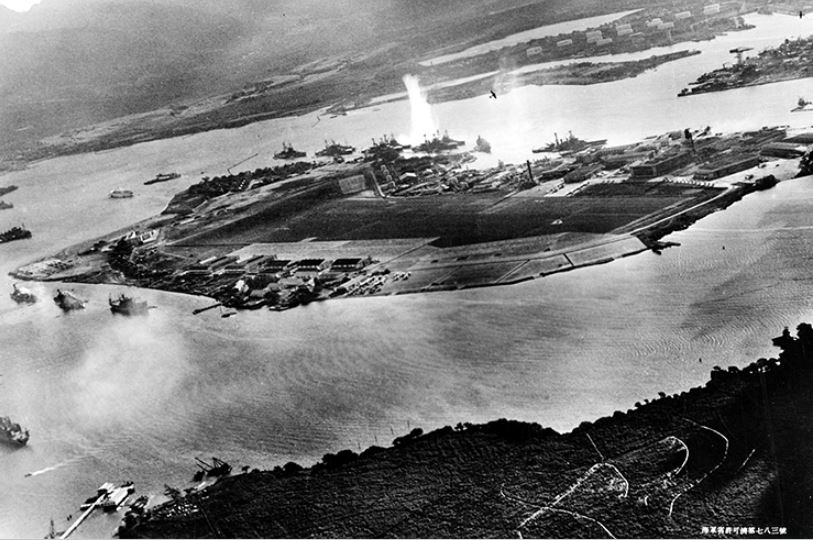
Over two thousand four hundred American sailors, soldiers and airmen were killed in Pearl Harbor 69 years ago today. Had we had an equivalent of WikiLeaks back in 1941, however, the course of history could have been very different. FDR would have found it much more difficult to maneuvre the country into being attacked in the Pacific in order to enable him to fight the war in Europe, which had been his ardent desire all along.

One leak—just one!—almost torpedoed Roosevelt’s grand design. In mid-1941 he incorporated the Army’s, Navy’s and Air Staff’s war-making plans into an executive policy he called “Victory Program,” effectively preparing America for war against Germany and Japan regardless of Congressional opposition and the will of the people. His intention was to lure public opinion into supporting the Program because the increase in weapons production promised meant more jobs and a healthier economy. A supporter of the America First Committee, Senator Burton K. Wheeler, obtained a copy of the Victory Program, classified Secret, from a source within the Air Corps, and leaked it to two newspapers on December 4, 1941, the Chicago Tribune (a serious newspaper back then) and the Washington Times-Herald (long defunct). Vocal public opposition to the plan erupted immediately, but ceased three days later, on December 7, 1941. Congress soon passed the Victory Program with few changes. The Japanese performed on cue.

Imagine the consequences had the Chicago Tribune and the Washington Times-Herald published a series of other leaks over the preceding few months, including the following:

Berlin, 27 September 1940. U.S. Embassy reports the signing of the Tripartite Pact, the mutual assistance treaty between Germany, Italy, and Japan: “It offers the possibility that Germany would declare war on America if America were to get into war with Japan, which may have significant implications for U.S. policy towards Japan.”

Washington, 7 October 1940. Having considered the implications of the Tripartite Pact, Lt. Cdr. Arthur McCollum, USN, of the Office of Naval Intelligence (ONI), suggests a strategy for provoking Japan into attacking the U.S., thus triggering the mutual assistance provisions of the Tripartite Pact and finally bringing America into war in Europe. The proposal called for eight specific steps aimed at provoking Japan. Its centerpiece was keeping the U.S. Fleet in Hawaii as a lure for a Japanese attack, and imposing an oil embargo against Japan. “If by these means Japan could be led to commit an overt act of war, so much the better,” the memo concluded.

Washington, 23 June 1941. One day after Hitler’s attack on Soviet Russia, Secretary of the Interior and FDR’s advisor Harold Ickes wrote a memo for the President, saying that “there might develop from the embargoing of oil to Japan such a situation as would make it not only possible but easy to get into this war in an effective way. And if we should thus indirectly be brought in, we would avoid the criticism that we had gone in as an ally of communistic Russia.”

Washington, 22 July 1941. Admiral Richmond Turner’s report states that “shutting off the American supply of petroleum to Japad will lead promptly to the invasion of Netherland East Indies: “[I]t seems certain [Japan] would also include military action against the Philippine Islands, which would immediately involve us in a Pacific war.”

Washington, 24 July 1941. President Roosevelt says, “If we had cut off the oil, they probably would have gone down to the Dutch East Indies a year ago, and you would have had war.” The following day he freezes Japanese assets in the U.S. and imposes an oil embargo against Japan.

London, 14 August 1941. After meeting the President at the Atlantic Conference, Prime Minister Winston Churchill noted the “astonishing depth of Roosevelt's intense desire for war.” PM is aware that FDR needs to overcome the isolationist resistance to “Europe’s war” felt by most Americans and their elected representatives.

Washington, 24 September 1941. Having cracked the Japanese naval codes one year earlier, U.S. naval intelligence deciphers a message from the Naval Intelligence Headquarters in Tokyo to Japan’s consul-general in Honolulu, requesting grid of exact locations of U.S. Navy ships in the harbor. Commanders in Hawaii are not warned.

Washington, 18 October 1941. FDR’s friend and advisor Harold Ickes notes in his diary: “For a long time I have believed that our best entrance into the war would be by way of Japan.” Yet four days later opinion polls reveal that 74 percent of Americans opposed war with Japan, and only 13 percent supported it.

Washington, 25 November 1941. Secretary of War Stimson writes that FDR said an attack was likely within days, and wonders “how we should maneuver them into the position of firing the first shot without too much danger to ourselves… In spite of the risk involved, however, in letting the Japanese fire the first shot, we realized that in order to have the full support of the American people it was desirable to make sure that the Japanese be the ones to do this so that there should remain no doubt in anyone’s mind as to who were the aggressors.”

Washington, 26 November 1941. Both US aircraft carriers, the Enterprise and the Lexington, are ordered out of Pearl Harbor "as soon as possible". The same order included stripping Pearl of 50 planes, 40 percent of its already inadequate fighter protection.

Washington, 26 November 1941. Secretary of State Hull demands the complete withdrawal of all Japanese troops from French Indochina and from China.

Tokyo, 27 November 1941. U.S. Ambassador to Japan Grew says this is “the document that touched the button that started the war.” The Japanese reacted on cue: On December 1, final authorization was given by the emperor, after a majority of Japanese leaders advised him the Hull Note would “destroy the fruits of the China incident, endanger Manchukuo and undermine Japanese control of Korea.”

San Francisco, 1 December 1941. Office of Naval Intelligence, ONI, 12th Naval District in San Francisco found the Japanese fleet by correlating reports from the four wireless news services and several shipping companies that they were getting signals west of Hawaii. There are numerous U.S. naval intelligence radio intercepts of the Japanese transmissions.

Washington, 5 December 1941, 10 a.m. President Roosevelt writes to the Australian Prime Minister that “the next four or five days will decide the matters” with Japan.

Washington, 5 December 1941, 5 p.m. At Cabinet meeting, Secretary of the Navy Frank Knox says, “Well, you know Mr. President, we know where the Japanese fleet is?” FDR replied, “Yes, I know … Well, you tell them what it is Frank.” Just as Knox was about to speak Roosevelt appeared to have second thoughts and interrupted him saying, “We haven’t got anything like perfect information as to their apparent destination.”

Washington, 6 December 1941, 9 p.m. At a White House dinner Roosevelt was given the first thirteen parts of a fifteen part decoded Japanese diplomatic declaration of war and said, “This means war!” he said to Harry Hopkins, but did not interrupt the soiree and did not issue any orders to the military to prepare for an attack.

As per that old cliché, the rest is history…


Tagged as: ,

62 Responses »

  1. #49 Robert,
    Thank you. He's probably referring to this: http://articles.cnn.com/2008-07-07/us/iraq.uranium_1_yellowcake-uranium-cameco?_s=PM:US: "The United States secretly shipped out of Iraq more than 500 tons of low-grade uranium dating back to the Saddam Hussein era, the Pentagon said Monday." Irrelevant as already addressed and dismissed, I would say.

  2. Prof. Wilson at #48, I'm not excluding FDR from the blame. To relate it back to Dr. Trifkovic's original piece here, FDR seemingly was willing to sacrifice his own countrymen so his betrayals in Europe are hardly surprising.

    I would go further than characterize the behavior of the British and Americans in this respect as something worse than "less than glorious". It was duplicitous and dishonorable. Mihailovich and his men, as well as entire villages in Serbia, risked their hides to rescue, preserve the lives of, and return allied airmen in the war effort. Even if they had an inferior military position to the communists - which they did not - the Allies should have stuck with them. Instead they were sold out such that Tito could prevail. As Tom Piatak has reminded us this directly led to the deaths of many and it led to the execution of Mihailovich and his officers who had done so much to save the lives of Americans. Incidently, those American airmen did not forget him. They have been outspoken in their outrage that we would betray our allies in the Balkans in favor of communist insurgents. These honorable soldiers worked hard to have Mihailovich posthumously awarded the Medal of Freedom. I do not blame them - I blame the politicians who sold them and the Balkans out.

    Your point about a Hitler-Stalin pact seems besides the point in this particular discussion. I am not condoning the behavior of those two monsters and not in anyway downplaying the death and destruction that they unleashed, but Britain and America need not have made it so easy for their henchmen to succeed in eastern Europe.

  3. The usual thing which I have noticed about people like Mr. Gilmartin is that they are of that sort which invariably care about the evils happening in other places, yet are obliviously blind to those evils which are perpetrated in/by their own house. On the contrary, they use the evil being committed by others as a justification for those committed by their own countries.

    As it is so well put in the New Testament, "Why do you look at the speck of sawdust in your brother's eye and pay no attention to the plank in your own eye?" (Luke 6:41) and "You, therefore, have no excuse, you who pass judgment on someone else, for at whatever point you judge the other, you are condemning yourself, because you who pass judgment do the same things." (Romans 2:1).

    Then again, Mr. Gilmartin and his ilk can keep singing the same tune, disregarding all other opinions... After all, the world was doing fine long before the United States came into being, and will do quite well on its own when it is gone.

  4. Mr Gilmartin, you'll have to provide better proof of the 'Nazi' character of the Baathist party, or of it's founder, than the absurdly unreliable Wikipaedia.

  5. #35,#33. Mr. Piatak, Mr. Gilmartin, please reread what I said, which is that COVERTLY Soviet Union could not overthrow any government anywhere in 1941. There was no chance that they could do so in Yugoslavia becuase among other reasons there was no institutional support within the country on any level for Soviets. This is equally true for the Baltics. As for Spanish civil war, I posit to you that this was the work of the Occidental left, whereas the Soviets were late comers and only allied with the communists once the Anarchists gained the upper hand in the revolution.

    The Soviets action in Finland and the Baltics, Poland cannot be understood as the success of the frendly simpathizers of communism but as naked agression.

    Mr. Gilmartin, I find it rather amusing that you are so bothered when it suggested Churchill and Roosevelt may not have been much better that HirohitoHitler, Mao and Stalin. How about Chang Kai Shek/ This leads me to believe that you would think Lincoln was the greatest of presidents. Of course this would not be a surprise.

  6. Also Mr. Gilmartin, you wrote:

    "Also read the McKay report."

    What did you mean by that?

    Was it this?

    "New Zealand's ambassador to the United Nations, Don McKay, told the assembly during an open debate that while the Government recognised the UN Security Council must be able to authorise force, it did not believe such action was yet justified." http://www.nzherald.co.nz/nz/news/article.cfm?c_id=1&objectid=3147128

  7. In the days of chivalry, a king as a knight would have to fight on the front lines with his own soldiers, and at worst would have to be present in the battlefield but not be fighting until the situation is desperate.

    As that line goes, "Let the boy win his spurs."

    Did the parliamentary armies of Churchill or Roosevelt ever see either Churchill or Roosevelt volunteering in any capacity as soldiers? Even in the simplest task of taking away the wounded from the battlefield and putting them under the medics? No. How ironic that feudal leaders showed more understanding of the greater sacrifice required by a leader than today's democratically elected despots do.

    Would it have ever happened that Churchill would have been captured by his enemies after a battle and then executed by them like Richard the Lionheart was? Of course not, and such a thing is almost unfeasible in this day and age. Just as well, one of the worst American warmongerers, Woodrow Wilson, was the only American leader with a PhD and has his loose parallel in India's Lal Bahadur Shastri, an ivory tower academic who led his country into the bloodiest war it ever fought.

  8. Compassionate Facist.
    Extremely interesting and fascinating item on the conversation between Churchill and Roosevelt in November, 1941. Astonishing this has not been mentioned in Stinnett's book. It would, if true, provide near perfect confirmation of FDR's intentions and action to get the U.S. into the war.
    Still, one pauses since Heinrich "Gestapo" Mueller seems to have disappeared in April, 1945, and, as far as I can find, is assumed to have perished in the battle for Berlin. How is it then that he provides evidence to the OSS in 1948?

  9. The Gestapo Chief series apparently was written by a known document forger who was good at using information which people who are interested in the subjects it covers already knew to be true as a cover for his fraudulent 'revelations'.

    There may be some truth in that series, but how to know what is true and what is not? I advise everyone to stay away from it.

  10. #58. Nonsense, Churchill saw action in the Boer War, where he was captured and escaped, and at Omdurran. Of course, Roosevelt and few other rich Northeasterners ever were in danger in WW II of anything worse than paper cuts.

  11. @11 Jodie,

    Dear Jodie,

    I was moved by your comment, and by the fact that you take for granted much that I've had to learn slowly and often painfully over the years. Also, it could be said that without the dislocations caused by World War One, my mother never would have left our farm in Connecticut and eventually met the young immigrant who became my father - in other words, as you put it so well, I would not be me.

    Briefly, we here in America, especially those of us who grew up right after WW 2, (the so-called "baby boomers") were immersed in the "official" history of the war, (and of many other things) which left out much that would embarrass our leaders. According to this official history, war was inevitable because the bad people (Nazis and Japanese fascists) wanted it and we good people had to stand up to them. This may yet prove to be true; but while new, or previously little known facts continue to emerge, we shall continue to think it "all revolutionary stuff".

    Even those who dug a little deeper, and learned that there were some behind the scenes maneuvering, some missed opportunities for peace, or at least for a better outcome, never guessed how involved our leaders were in the maneuvers, how many branches there were to the story and how deep its roots went into the past. Either the information was not yet available because still secret, or only those with specialized knowledge in how to do research (remember, no internet then) or who had contact with insiders knew the full story. Even today we don't know everything. Furthermore, those born before 1960, as were many of us who comment on this site, were surrounded by the popular culture's - especially Hollywood's - simplistic portrayal of American heroism and the glory of our triumph. The heroism and triumph were real, and it was hard to feel anything but hero-worship for the G.I. s who sacrificed so much, and admiration for the leaders who directed their efforts. But that one-sided concentration on the victory, without any thought as to the larger questions of whether war was necessary or unavoidable to begin with, or whether certain actions had to be taken and others omitted, would come back to haunt may of us years later, as more facts came out; even Dr. Chakoian's comment @8 is news of sorts to me, since the war veterans themselves have only relatively recently begun saying what they knew.

Trackbacks

  1. Daily Reading (and open thread) | Conservative Heritage Times