Your home for traditional conservatism.

Of Mary and Crystals

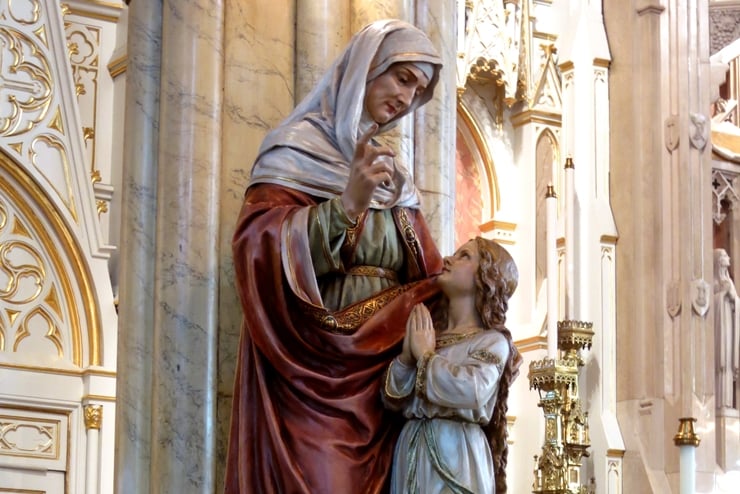
Heather Mac Donald is a very good journalist, and conservatives are in her debt for her work dealing with immigration, crime, and the realities of urban life.  But Mac Donald, an atheist, is puzzled by religion.  Last Sunday, this puzzlement took the form of a short piece at the Secular Right website, where Mac Donald expressed her shock at seeing a flyer for “one of those creepy painted sculptures of Mary with oversized, tear-encrusted eyes and an undersized mouth” in her apartment building in Manhattan.  The flyer was for a visit of a statue of Our Lady of Fatima at a nearby church, a church that is apparently a bit too close for Mac Donald’s comfort.  “I ask in all sincerity:  are Secular Right’s fellow highly-educated conservatives ready to prostrate themselves before, and put a toy crown on, a wooden effigy?”  Mac Donald also wrote that “I honestly don’t know how to distinguish the worship of a wooden icon from the belief in the healing powers of crystals or in the predictive power of entrails.  I know I must be missing some essential distinctions here, but for the moment they elude me and I remain at a loss to understand.”

The day before Mac Donald expressed her puzzlement at Marian devotion in Manhattan, Scott Richert had a piece at his Catholicism blog at About.com that might help Mac Donald in gaining understanding.  As Scott explained, Catholics do not worship Mary or the saints:  “When we honor the saints, we honor God, because He is their Creator and the source of their sanctity.  When we pray to them, we take nothing away from God, to Whom we also pray; rather, we ask them to intercede for us, just as we ask our living friends and relatives to do.”   Catholics believe “that all Christians, living and dead, are one in the Body of Christ,” and “The use of statues, icons, and other images of the saints reminds us of this fundamental truth and draws us closer to each other in Christ by increasing our devotion and leading us to imitate the actions and faith of the saints.”  (My wife’s theological reaction to Mac Donald’s piece was similar, even as we fondly recalled the time we both knelt, on our wedding day, before a statue of Mary and presented Our Lady with flowers my wife had picked out, as the choir sang Tomas Luis de Victoria’s exquisite Ave Maria for four voices.  One hopes that such a scene, customary at Catholic weddings, does not also disturb Mac Donald’s sensibilities.)

But is there a non-theological way to distinguish Marian devotion from “belief in the healing powers of crystals or in the predictive power of entrails"?  I think there is.  Marian devotion has produced more than “creepy painted sculptures”; it also produced Michelangelo’s Pieta and his Bruges Madonna.  There are innumerable architectural gems dedicated to Mary, including the great cathedral in Chartres that so captivated one of America’s distinctive geniuses, Henry Adams.  Belief in crystals has yet to produce a Pieta or a Chartres.

It would be easier to list the European painters who have not painted Mary than the ones who have.  Indeed, it is no exaggeration to state that the Western artistic tradition began with Italian painters creating religious images as aids to prayer, a fact well known to the Metropolitan Museum of Art in Mac Donald’s Manhattan, which paid a record $45 million for a painting of the Madonna and Child by Duccio a few years back, a price the museum would not pay for a painting inspired by the harmonic convergance.  And then there is the music.  Apart from the Mass, no liturgical text has been set to music more often than the Magnificat, and major European composers have also given us numerous settings of the Ave Maria, the Stabat Mater, and the great medieval Marian litanies.  One thinks of Bach’s Magnificat, Mozart’s Regina Coeli, the Stabat Maters of Palestrina, Pergolesi, and Dvorak, the Ave Maria of Schubert, which began as a setting of a Marian prayer offered by the heroine in Walter Scott’s Lady of the Lake.  Once again, an easy point of distinction, since no reasonable person would have difficulty distinguishing the unmatched musical tradition of the West from dreary “New Age” music, some of which might conceivably have been inspired by a belief in the healing power of crystals.  Nor has art inspired by Mary died out.  Gorecki’s haunting third symphony features several Marian songs, Franz Biebl’s lovely Ave Maria has begun to gain the popularity it deserves, and the man Tom Shippey dubbed “The Author of the Century,” J. R. R.  Tolkien, wrote that “all [his] own small perceptions of beauty both in majesty and simplicity” were founded on “Our Lady,” as the elvish invocations to Elbereth and Sam and Gimli’s reactions to Galadriel suggest.

Another distinction between devotion to Mary and a belief in crystals is the role that Marian devotion has played in the West’s struggle against its enemies.   As Christopher Check notes in his article in This Rock on “The Battle that Saved the Christian West,” Don John of Austria had rosaries distributed to all the men in his fleet before the battle of Lepanto, and the Genoese admiral Gianandrea Doria sailed with an image of Our Lady of Guadalupe on his ship.  A century later, Polish king John Sobieski stopped to pray before Our Lady of Czestochowa before riding off to help break the Turkish siege of Vienna, a battle that began, according to historian Tim Blanning, “with a great shout of ‘Mary, help us!’”   More recently, Marian devotion played a role in the struggle against atheistic communism, beginning with the “Miracle on the Vistula” as the advancing Red Army was repulsed from Warsaw in 1920 and culminating with the peaceful efforts of Solidarity, whose leader always wore a small image of Our Lady of Czestochowa on his lapel and who left his Nobel Peace Prize as a votive offering at the monastery housing the image of “the Queen of Poland,” just as Sobieski deposited the Turkish booty he brought back from Vienna at the monastery.  Indeed, many have argued that one of the ways the Polish Catholic Church kept the spirit of resistance to communism alive was by having a reproduction of the icon housed in Czestochowa visit each parish in the country as the Church prepared to celebrate the millennial anniversary of Poland’s conversion to Christianity.  These visits were marked, no doubt, by many believers prostrating themselves before the image of their Queen, much to the aesthetic and political horror of the commissars, who wanted the Poles to bow only to Moscow and who would have been delighted if the cult of Our Lady of Czestochowa, so engrained in the history of the nation, had been replaced by “belief in the healing powers of crystals” or an equally ephemeral alternative.

Another distinction is suggested by the saint whose feast the Catholic Church celebrates today, Maximilian Mary Kolbe.  Kolbe was greatly devoted to Mary:  He founded the “Militia of the Immaculata” to encourage Marian devotion, and he dedicated his own life to Mary as he prostrated himself before a painting of the Immaculate Conception at the seminary in Lviv.   These beliefs steeled Kolbe for the great test fate had in store for him.  When the Nazis invaded Poland, he used the friary he had established at Niepokalanow, “the City of the Immaculata,” to house thousands of refugees, Jews and Catholics alike.  Such deeds caused Kolbe to run afoul of the Nazis, who sent him to Auschwitz, where he calmly endured the sadism of the guards and offered spiritual and material comfort to his fellow prisoners, often sharing his meager rations with them.  Then, in July 1941, a prisoner escaped.  As a punishment, ten others were chosen by the Nazis to be killed in a starvation bunker.  One of these men, Franciszek Gajowniczek, began lamenting what his death would mean for his wife and children.  Upon hearing these cries, Kolbe volunteered to take Gajowniczek’s place and was sent to the starvation bunker in his stead. In the bunker, Kolbe became the leader of those awaiting death, whom he was often seen consoling and leading in prayers and hymns.  Two weeks later, only four of the men were still alive, and Kolbe alone was conscious.  The Nazis killed them all; Kolbe was seen calmly giving his arm to the executioner who injected him with carbolic acid.  The memory of Kolbe’s courage and selflessness lived on in those who survived the Golgotha of Auschwitz, including Gajowniczek, who lived to see Kolbe canonized.

I am not aware of any figure comparable to Kolbe who has been shaped by “belief in the healing powers of crystals.”  Nor am I aware of any schools, hospitals, or other charitable institutions founded on “belief in the healing powers of crystals,” although every corner of America has such institutions founded by men and women sharing Kolbe’s beliefs.  I hope that the “essential distinctions” between Kolbe’s beliefs and a belief in crystals are clear to all conservatives, religious or not, for the simple reason that Christianity created our civilization and a belief in the healing power of crystals and the like has created nothing of value. As British essayist Theodore Dalrymple, himself a non-believer, observes, “To regret religion is, in fact, to regret our civilization and its monuments, its achievements, and its legacy.”  And the first step toward safeguarding that legacy is to recognize the enormous role Christianity played in the creation of our civilization, no matter how disappointing individual Christians might appear.


Tagged as: ,

45 Responses »

  1. Mr. Piatak,
    Thank you for this thoughtful reflection. There are no doubt visible consequences of the life of grace. Michelangelo’s poetry alone would attest to this fact. One thing about Heather McDonald is she is a thoughtful and honest,young woman, but also an example of the real betrayal of our educational institutions. No college graduate, however deprived in their days of youth or spoiled during their days as young adults, should hold some of the positions she holds. The very term, "secular conservative", would have made a man of Bertrand Russell's frame of references blush red with astonishment.
    Personally I do not think it helps to diminsish the "Hocus Pocus" aspects of the Christian faith for the higher cultural conclusions that can be drawn from it. There remains a profound mystique to human life that the fine arts, high scholarship and a lifetime of learning simply cannot account for in terms of measurements or "metrics." But it is the preferred method of contemporary times and perhap the only prudent one that can engage the young aspiring minds of our time. My advice for folks like Heather is not instructions in the faith but the dialogues of Plato, the complete poems of Robert Frost or a novel by Walker Percy. She is immitating some of the best teachers and friends she has acquired over the years and that goes to the quality of ones education, not its quantitiy.

  2. Well done! Belief in the Christian tradition, including the intercession of Mary and all the saints directs man’s focus away from himself, and underscores one of the most fundamental tenets of our faith, namely that we cannot achieve salvation through our own devices, but need to strive to eliminate our selfish desires and instead trust in God. New Age ideas, such as belief in crystals, are diametrically opposed to Christian philosophy in suggesting that man can achieve fulfillment through his own selfish and self-centered efforts, essentially deifying himself.

  3. I once inspired a couple of posts at Secular Right when it was new because I said that "Secular Right" is an oxymoron. I don't doubt that individual secularists can be rightists, but there can be no large scale truly secular right because secularism is of wholly left-wing origin. What is a secularist conservatism trying to conserve? It by its very nature displays contempt for something most conservatives consider essential (in fact the most essential) and in need of conserving against said secularists.

    As my fellow conservative protestants would say, these secularist conservatives just need to “get saved.”

  4. Dr. Phillips is on target, as usual.

  5. I LOVE this article. Clearly Ms. McDonald hasn't really tried to understand what all of the Christian traditions mean to those of us who believe. All she needed to do was to ask one of us. She, like so many other athiests try to discredit Christians by making them look like fools who worship a piece of wood, or marble. We don't worship those items, we simply worship and respect what they represent. That is ...the immense spirit and power of God. Everything that we have and do is a gift from God and we honor that by the way we live our lives mentally, physically and spiritually. It is those very athiests who, in error, worship the material things in life. So much so that they can't even imagine the power that inspired the creation of the many works noted by Mr. Piatak. I find it tragic that there are those lost people who do not have a faith, and therefore a moral compass by which to live their lives. I will continue to pray for Ms. McDonald so that she can begin to find answers to all of her questions.

  6. Kolbe, a Christian got executed at Auschwitz? Why am I only hearing about this now? The way the legends are fluffed up these days one would think only jews were put to death there. Thanks for the enlightenment Tom.

  7. MacDonald argues that the conservative position can be advanced by the simple propagation of social science evidence that traditional practices (like the nuclear family) are more socially beneficial than alternative arrangements; religion is not a necessary component of this process. The problem with her analysis is that the current popularity of hedonistic liberalism has as much to do with a deficit of altruism as a deficit of knowledge. Lacking a disposition towards charity and the higher things, people are unlikely to make substantial sacrifices for the common good. Religion, of course, tends to be the source of such a disposition.

  8. I am tempted to tease Dr. Phillips by saying his comment sounds like Sen. Lieberman's "you can't have morality without religion" comment, but that would just be mischievous.

    Of course, he is correct. The "secular right" forgets, as does the "secular left", that they enjoy the patrimony of centuries of Christian faith in their societies. The very concept of liberty (which always trumpeted by the secular right) has its origin in the Christian faith and would have no existence in our modern world without it.

    This is not a matter of theological disagreements over Marianism or other particular doctrine (which can be put aside for purposes of this cultural discussion.) But of the origin of the culture out of which the alleged "universal values" trumpted by the secular right arose.

    (And I must say that some of these secular right figures seem inordinately uncomfortable with the faith of others, bringing to mind the Lord's comment from John 3:19-20.)

  9. A wonderful piece. As to the Secular Right, I'm reminded of Dr. Johnson's famous quip on Hume, "He was a Tory by chance."

    The Secular Right (or the Secular Left, for that matter) also never recognizes that modern science actually started in the Middle Ages because of belief in the Incarnation and the veneration given to Mary as the Mother of God. The late Fr. Stanley Jaki, a physicist and historian of science, wrote in "The Savior of Science" (Eerdmans, 2000) in Chapter 2, "The Birth That Saved Science":

    "The Trinitarian dogma is anchored in perceiving a concrete flesh and blood being, Jesus of Nazareth, as *the* son of a God whom Jews as well as Muslims are fond of calling Father. For Christians, Jesus is an only Son in a sense that prompted on their part a revolutionary break with Greek semantics. That break was expressive of the manner in which the life, words and actions of Jesus suggested a radical break with all known human patterns. With the Greeks and Romans the expression 'only begotten' (*monogenes* or *unigenitus*) had the universe for its supreme reference point....

    "It should be obvious that the universe had to lose its status as only begotten in the eyes of those who called a flesh and blood being the *only begotten* Son of a Divine Father and did so in the most exalted sense that could be formed by human minds."

    The whole book is worth reading.

    (Tom, could you please list any other sacred music by modern composers? I'm always looking for it.)

  10. Mr. Piatak,
    Thank you. Us ignorant and superstitious Christians with a devotion to the Mother of God appreciate your insight.
    Anastasia, what a pleasure to have you back. Such a joy!
    Let us not be bothered with the secularist and their foolishness. (To deny the supernatural is unnatural, as G.K. reminded us.)

  11. A certain Josephin Peladan, a personage of the XIXth Century occult revival in Paris, delivered himself of the following "pontifications" in 1883:

    1. All artistic masterpieces are religious, even amongst unbelievers.

    2. For nineteen centuries, artistic masterpieces have always been Catholic, even amongst Protestants.

    James Webb, author of the Occult Underground LaSalle, Illinois (Open Court Library Press: 1974), goes on to say of Peladan: "Thus the critic ranged himself squarely on the extreme of the Catholic reaction, an attitide he was to maintain even in his occult dealings..." (loc. cit. p. 169)

  12. Mr. Pinkerton,
    It is probably more helpful to substitute the word, Tradition, for Peladan's use of the word Catholic, as he was probably experimenting with methods outside the communion of saints or practices the Church had already condemned in earlier periods. William Butler Yeats is a more recent example as well as some of the French symbolists such as Rimbau or Bauldelaire. I haven't read Webb's book and probably won't because Plato's Ion or the Christian Bible are the classic references to the sources of what we would call inspiration, or that "spirit that comes from we know not where, and goes to where we know not where." I suspect a modern journalist like James Webb would be surprised by a convergence of views from different historical periods because in contemporary parlance, it is supposed to be man who orders our accidental and chaotic universe in each historical period to his individual and/or (by social contract I suppose) collective advantage. Thus for him, these various occult writers he mentions would be engaged in a conspiracy for power, rather than inspired by what Dante described as "the Love that moves the Sun and all the other stars." Some scholars refer to Dante as an occult poet, which means their use of the word occult is entirely diffferent than the teenage goons in California, killing cats, offering incense, tripping on acid, listening to the recorded music of Jimmy, Janice and Ja, while repeating the local yogi's mantra they paid money to learn, "the occult man, the occult!!"

  13. Beautiful, Tom, beautiful. Bishop Sheen dedicated every one of his books to Mary. He believed that the only hope for Islam is that Mary has some significance for them. She guided us through the Cold War, why not through this next one?

  14. Mr. Seiler:

    I would recommend the CD by John Rutter and the Cambridge Singers called "Ave Gracia Plena: Music In Honor of the Virgin Mary," which has some more recent compositions in addition to wonderful chant and polyphony. Rutter himself has written a Magnificat. Another well known contemporary Magnificat is Arvo Part's.

  15. Rich Thomsen writes: "MacDonald argues that the conservative position can be advanced by the simple propagation of social science evidence that traditional practices (like the nuclear family) are more socially beneficial than alternative arrangements; religion is not a necessary component of this process."

    It took me a while to realize that many so-called "theocons" argue just the same way. They refuse to draw on their professed religion even in personal discussion.

    In addition to a superficial secularism, MacDonald has probably been malformed and misinformed by a self-neutering intellectual Christianity.

  16. There is something highly disturbing about Ms. Mac Donald's writing. She says that "I know I must be missing some essential distinctions here, but for the moment they elude me and I remain at a loss to understand." This sentence is beautiful only because it exemplifies the dishonesty and maliciousness that hides behind the militant secularist. How old is this woman? She honestly has never bothered to look back to the history, theology, or philosophy that sustained Western civilization for more than a millenia?

    It is obvious that the only reason the Faith eludes her is because she wants it to. I dabbled in pop philosophy and atheism while I was a teenager, but I realized very quickly that one cannot even be an atheist without first being a Christian. By this I mean that no intellectually fulfilling atheism can persist without giving merit to the entire body of both ancient Greek and Catholic philosophy. Subsequent to this realization I found that there actually isn't much atheism that does this. Mad Donald, for example, feigns sincere ignorance at religious piety, which she cannot help but see as pure superstition. What she is really admitting, though, is that she is an idiot. A person who can mock and condescend to a whole body of believers without rigorously considering their rich history of philosophy and theology, not to mention science, art, music, and everything else worth doing, is only betraying the fact that they have the intellectual maturity of a rebellious high school teenager.

    And finally, just to make work of her sophistry, Ms. Mac Donald should ask herself if, when she is observing a photograph of her mother, she keeps the picture because she loves the picture as a picture or because she loves what the picture represents. If she cannot see this then it truly does elude her. But, then again, she won't be able to maintain her status as an intelligent woman as a result.

  17. You are not supposed to 'pray' to saints or 'honor' anything except the Father who sent the Messiah. A neo pagan sun worshipper would feel right at home in a Catholic temple.

  18. Its nice to know, Yeoman, that the Catholics can rely on some Protestants to join with the atheists in the war against Christianity. As if it isn't obvious enough, the minute you and Ms. Mac Donald stop laughing to yourselves about Catholics and their ridiculous theology, she will turn on you and call you a superstitious pagan as well. Its not Mary per se or anything else in particular that she or the other Secular Rightists find laughable, its the faith in its entirety. Think of that before you engage in meaningless polmics that contribute nothing to the conversation.

  19. I feel sorry for Yeoman's parents, if he came to this revelation while they were still alive.

  20. "A neo pagan sun worshipper would feel right at home in a Catholic temple."

    Hopefully he would, as he should, for Christ, The son (or sun) of God came to fulfill the old law not to destroy it. On a more serious note,however,I was wondering why some churches don't bend the knee or bow the head at the mention of the Holy Name. Also,is the reason that some of the puritan branches of the tradition call their natural father, "pops," or "old man" because they read in the book that no man should be called Father? Finally, I was wondering why folks like Yeoman have no problem with the civic Medals of Honor for Valor, or patriotism, or Hall of Fame sportsmen, Televangelists, etc., but think immitating the virtues of a holy or charitable man or woman is so scandalous for the true Christian.

    Edward @19
    "Its nice to know, Yeoman, that the Catholics can rely on some Protestants to join with the atheists in the war against Christianity." This is unfortunately true and in many instances. But I have come to understand that the Protestants do much better when the Catholics are actually practicing their Faith. There is little room for pride in the authentic life of grace for to whom much is given, much will be expected. But, heck it doesn't take a rocket scientist to see that neither side is doing much these days.

  21. @15, Mr. Piatak:

    Thank you.

    I checked the Secular Right Web site. They seem to be more interested in attacking the religious than in advancing conservatism, libertarianism, or whatever else is on the Right these days.

    Why can't they just say, "We don't believe. So here are some non-religious arguments for conservatism, limited government, the Constitution, free markets, etc."

    I don't have time enough to survey the whole site. But they also don't seem to deal with this major problem: Unbelievers must have a birth rate below 1.0 per woman. It might be as low as 0.5. (With 2.1 being replacement in industrial countries.)

    So if atheism or agnosticism became the view of everybody, the human race would become extinct.

  22. MacDonald went to Andover years after I did, and is obviously an intelligent woman.

    It was rather liberal Protestant then (remember Wm. Sloane Coffin?), but we had to read the whole Bible and certainly graduated knowing something about what Christianity taught and what its history was.

    It's unnerving not so much that she doesn't believe, but that she doesn't remotely understand.

  23. Regarding Kolbe, some may find the extremely poignant short story "Japanese In Warsaw" by Japanese Catholic Shusaku Endo interesting.

    Like Graham Greene, Endo was problematic but also had his brilliant moments, as in this instance.

    Prior to his martyrdom, St. Kolbe had apparently done an assignment in Nagasaki....I believe this is a true portion of his biography, used by Endo.

    As to Mr. Yeoman's thoughtless quip ... ummm, well, actually, now that you mention it, the "pagan sun worshippers" in Japan didn't take such a kind view to Japanese Catholics.

    As a matter of fact, they crucified them.

  24. Mr. Salyer,

    Yes, Fr. Kolbe spent six years in Asia, mostly in Japan, and founded a friary in Nagasaki.

  25. Fr. Kolbe also published a daily newspaper, and a monthly magazine. He had a short-wave radio station, and was planning a motion picture studio, as well as missionary centers (like the one in Nagasaki) worldwide. They called him the apostle of the mass media. Thank you, Mr. Piatak for the great essay.

    Mr. Seiler -- here are more composers of modern sacred music you might want to search out : John Tavener; Alan Hovhaness; Virgil Thompson. (Olivier Messiaen was apparently a devout Roman Catholic, although I wouldn't recommend his music). Recorded works of less famous (or unknown) composers of sacred music could be sought through independent outlets such as CD Baby, or their concert performances through the music composition faculty at universities.

  26. @22 Mr Seiler

    Unbelievers must have a birth rate below 1.0 per woman. It might be as low as 0.5. (With 2.1 being replacement in industrial countries.)

    The concept of the earth being "overpopulated" came about in the late 18th Century in the teachings of Rev. Thomas Malthus - the father of that dismal science, economics. The Anglicans have strayed ever leftward since then, up to next next wacky stunt bandided about by stand-up comedians. God knows what the Blessing of Animals will evolve into!

    Plenty of civilizations in China depended on a growing birth rate, because any ruler and his advisors worth their salt knew that war and natural disasters were always going to deplete his subjects. There is really something hopeless with the West's current cultural suicide. There is good news, however, some parents are opting for another kid and figuring out that college in this day and age is a waste of money, and can be safely removed from the budget calculated to raise another heir. Apparently trusting Social Security and other state bureaucracies is getting unfashionable. Pray for this movement to grow like topsy.

  27. I recently read an essay by an atheist explaining why he was one. Of course, his lengthy explanation didn't state the real reason he was an atheist. For some reason God had not given him the gift of faith. We should thank God everyday for the gift of faith that He has given us and try to live up to that faith in every way each and every day.

  28. The Russian Orthodox Bishop Hilarion Alfeyev has written some beautiful choral music. You can find it on Youtube, among other places.

    Also check out the French Catholic composer Duruflé.

    Both are fine composers in my not-very-learned estimation.

    (Not to speak of Rachmaninoff, who is no longer contemporary, I suppose).

  29. Heather MacDonald and her fellow "secular rightists" are sufferable to me only so long as they refrain from the annoying leftist habit of demanding the imagined right of having their uninformed opinion (which is all atheism amounts to) defended against exposure to the public profession of faith by any Christian. Ms. MacDonald contents herself with whining that she doesn't get it, rather than calling for police to arrest the hosts of the statue's visit. That is the main difference between the "secualar right" and the atheist left, in my view.

    Leftists' insistence on a misapplication of the 1st Amendment is what clearly illustrates the inherent evil of collectivist politics, since their hostility is directed only at Christianity. The secular right is mainly identified by atheism, isn't it? That being the case, it's difficult for me to presume that the secular right is any sort of ally of conservative Christians at all, despite their pretense of support for the Christian ideals of free trade and limited government.

    My view of the secular right is that they have much more in common with their purported adversary, the atheist left, than they have with conservative Christians. They use the word 'secular' to signify their aversion to Christianity rather than any simple separation between religious belief and political practice. With these atheists, "secular" is a code word for "atheist". Were they to refer to themselves as the atheist right, they would be much less likely to be regarded as allies by Christians.

  30. Heather has posted a courteous reply to Mr. Piatak over at the Secular or Atheist Right.I really enjoyed her last, honest statement of the reply: "None of this tells me whether the supernatural tenets of any given faith have sufficient empirical support to justify rational adherence to them." Good for her, at least she admits to "the reign of quantity" in her intellectual life as she awaits what the poets describe as "for once, then something." which may be more than most folks espousing Faith, Hope and Charity can about themselves.

  31. Ms. MacDonald's response to Tom, unfortunately, reflects the adolescent thinking that typifies atheists. She trots out the trope of "innocent suffering" to negate religion. This of course ignore the condition of men as sinners (Job teach that, in fact, no men are innocent.) And the purpose of grace, it is apportioned by God's nature not the merit of men (who have none.) For the innocent to be absolutely shielded from suffering is not taught in any of the revelation and would simply be the opposite side of the same coin to the doctrine that a person suffering must have sinned and deserves his fate (which Job also negates.)

    Of course, what makes MacDonald's viewpoint adolescent is not simply that it is ignorant of the rather obvious points above, but atheism no more answers the question, according to her formulation, than does faith in Christ. The difference is only that MacDonald is left without hope ("and hope does not disappoint", as the Apostle wrote.)

  32. Brilliant piece, Tom.
    Apparently there are Turkish accounts of the Battle of Lepanto that describe a woman appearing in the sky "terrible as an army set in array" (to borrow a phrase), who struck fear in the hearts of the Turks. Altogether believable, since we know the Blessed Virgin's intercession caused the wind to shift 180 degrees in favor of the Holy League. Both of the military victories Tom mentions are honored today on the liturgical calendar as is the ultimate defeat of Napoleon: Our Lady Help of Christians.
    Also, I recall hearing that the Annunciation is the most painted scene in art.
    Concerning Pagans and Catholic "temples." Was it Chesterton who speculated what a pagan would say if he wondered into a modern protestant church? "Where is your altar?"

  33. Mr..Wilder,
    I don't want to defend the poor woman except to say that she would be an authentic republican candidate for any adminstration. She is all opposite to me in matters of economics, culture, philosophy,and theology yet is representative of all that is considered conservative in the contemporary world. Until conservatives see the root of what is missing, or the essence of what conservatism is inthe Western world, they will never even begin to conserve anything worth conserving --politically or otherwise.

  34. Ms. MacDonald belies her adherence to ideology when she says that “None of this tells me whether the supernatural tenets of any given faith have sufficient empirical support to justify rational adherence to them.” Nobody has ever claimed that there is sufficient empirical support to justify rational adherence. But the very idea that something must have empirical support in order to rationally believe it is preposterous. 2+2=4 is true despite the fact that there is no empirical evidence to suggest it. Has she ever even read Plato or Aristotle, or, for that matter, any philosopher worth his salt? This is laughable.

    I would also suggest that her constant raising of the existence of evil shows how truly ignorant she and her readers are. When I was young I asked the same question: "How can there be a God is there is evil?" It is at least understandable even if it doesn't actually disprove God's existence. The difference between my asking the question and her asking the question is that I really wanted to know the answer. 2000 years of Christian tradition (Augustine, Aquinas, and many, many others) also took this objection seriously and answered it conclusively. My question, then, is this: If Ms. MacDonald and others are just so curious to know how evil can co-exist with God, why don't they stop typing and start reading. Mr. Piatak is a fine writer and an exceptionally intelligent man, but the burden is not on him or anyone else to answer these sophomoric questions when people will not even take the time to read what the classical Christian tradition has to say on the matter.

  35. Just to throw a little gas on the Catholic-Protestant fire, what is the Protestant view of history from the Ascension of Christ and the advent of Martin Luther? Was it all a big mistake? Was it 1500 years of emptiness? Was the institution that created Christian Civilization, the Roman Catholic Church, just one big hoax perpetuated by self-interested con-men? Was Peter not named by Christ as leader of His Church on Earth prior to His Ascension? Did Christ make a mistake by naming Peter his earthly successor or did Peter lie to get the job? Inquiring minds would like to know.

  36. Mr. Leaberry,

    I love your comments, but my advice would be to hold off on the gas. As I've stated before, my view is that if orthodox Christians do not hang together, we will assuredly hang separately. (Yes, I know I'm paraphrasing a deist, but Ben Franklin's point is applicable to our situation today).

  37. "Nobody has ever claimed that there is sufficient empirical support to justify rational adherence. But the very idea that something must have empirical support in order to rationally believe it is preposterous."

    Thank you, Mr. Edwards. You have restored my minute faith in the possible existence of a conservative remnant in two sentences.

  38. Great article. I believe it was Chesterton who said that when a man does not believe in God he will not believe in nothing; he will believe in anything. Modern America has proven his point to the "nth" degree. I can't help but chuckle when I hear moderns self righteously condemn the medievals for their ignorance and superstition....and then go have their palms read. Perhaps Ms. McDonald should spend some time actually trying to learn about the Catholic Faith and the basis for Marian devotion rather than simply be mystified by it. She might find a Pearl of Great Price and be, in the words of C.S. Lewis, surprised by joy.

  39. In response to Derek Leaberry #37:
    "Just to throw a little gas on the Catholic-Protestant fire, what is the Protestant view of history from the Ascension of Christ and the advent of Martin Luther? Was it all a big mistake? Was it 1500 years of emptiness?"

    At the considerable risk of over-simplifying, there are three types of Protestants.
    In my (relatively conservative)Presbyterian church, we recite the Apostle's creed every Sunday. The Minister often quotes St Augustine or St John Chrysostom, or some other church father (though not Aquinas!).
    In mainstream liberal churches, where the Lord's prayer often starts "Our Father/Mother", they go out of their way to denigrate the early writings of the church fathers, and not only the early ones, but all "dead white theologians".
    In the non-mainstream churches, where the stress is on individual salvation, there is more ignorance than rejection, and the certainty that early church fathers are irrelevant.

  40. Thank you for your answer, F. Ajami. The history major in me forces me to wonder what my Protestant brothers think about history from 32AD-1517.

  41. In furtherance of what F. Ajami said, aside from those types that he described, there are those kooky cultists who claim that from the time of the earliest Christians, there was no true Christianity until the founder of their cult heard the voice of God in the early 19th century and re-founded the true Church. They either know nothing of the history of Christianity or reject it all. These are the craziest of all protestants by far.

    I dont see how serious Christians of any denomination can ignore the early fathers or the rich history Christendom during the middle ages. To do so is to lose all understanding of real Christianity, and it's not just protestants. Some Catholics, perhaps a great many, are ignorant of it as well.

  42. Some Catholics, perhaps a great many, are ignorant of it as well.

    Sadly, all too true. Even more so—it's not just those Catholics who think that Catholic history started (or was restarted) with Vatican II.

Trackbacks

  1. First Thoughts — A First Things Blog
  2. Secular Right » Icons
  3. We’ve Been Arguing About This Since 787 (And No, I Don’t Mean Health Care) « Around The Sphere