“The New Englandeis are a people of God, settled in those which were once the Devil’s territories.”
—Cotton Mather
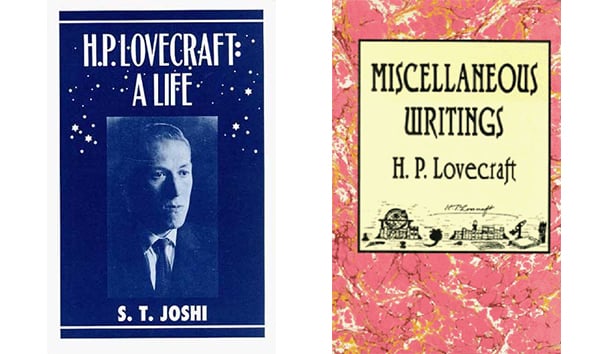
S.T. Joshi begins his mammoth biographical study of Howard Phillips Lovecraft by quoting his subject’s reaction to a suggestion from a fan that he write his autobiography. With the almost pathological modesty that characterized Lovecraft throughout his life, he snorted in response, “One might as well write the pompously documented biography of a sandwich man or elevator boy in 8 volumes.” If there is one theme that runs throughout Lovecraft’s voluminous correspondence, it is that he never had any illusions that the obscure life he led was worth writing about or that the supernatural horror fiction he wrote, and on which his fame today rests, was worth reading. It is both fortunate and unfortunate that those who have succeeded in turning H.P. Lovecraft into a cult (in some quarters, almost a religion) as well as an industry have paid no attention.
Born in Providence, Rhode Island, in 1890 to a declining high-bourgeois family of New England old stock, Lovecraft lived, or rather endured, a life and writing career that can only be judged failures. His father, a traveling salesman, died in a local insane asylum from what must have been syphilis when Lovecraft was eight. His mother smothered him with possessive and crippling affection and incessantly sought to bind him to her by insisting he was “hideous.” She died in the same asylum in 1921, after two years’ confinement. Dependent on his grandfather’s business for their income, Lovecraft and his family were obliged to leave their home during his childhood and take up far more modest quarters when the business failed. Afflicted from early youth by nightmares, macabre dreams, and a “nervous temperament,” Lovecraft was unable to complete high school and entered adulthood a reclusive and even neurotic young man, utterly unprepared to earn his own living and utterly disinclined to try.
Something of a child prodigy who translated Ovid into heroic couplets at the age of 10 or 12, Lovecraft succeeded in inventing his own world as a substitute for the one in which he was unable or unwilling to participate. As a child and adolescent, he not only immersed himself in 18th-century English and ancient Roman literature and history but acquired a genuine expertise in his hobbies of astronomy and chemistry. He was writing newspaper columns on astronomy at an early age and planned a career as a professional astronomer, but his lack of mathematical aptitude and his inability to complete high school made that career impossible. Instead he turned to amateur journalism, to crafting dreadful poetry that was usually little more than clever imitations of the Augustan masters he adored, and eventually to writing short stories based on his nightmares and heavily influenced by the major literary hero of his youth, Edgar Allan Poe.
In the 1920’s, there emerged a small national market for the genre of popular literature known as “supernatural horror” or “weird fiction,” mainly through a now-famous pulp magazine called Weird Tales. Lovecraft published frequently in Weird Tales and similar pulps in that period, and indeed the principal reason they are remembered today at all is because of him. But even there he did not fit. His stories were often rejected by Weird Tales‘s eccentric, mercenary, and largely incompetent editor, Farnsworth Wright, and in truth Lovecraft’s own highly original and distinctive tales of horror simply did not conform to the formulas on which Wright and similar editors insisted.
In 1924, Lovecraft married a woman named Sonia Greene, but in marriage too he was a failure. Unable to find a job in New York that could support both of them, he lived on her earnings as a fashion designer. He was never comfortable doing so, nor indeed in being married at all, and he insisted on divorcing her in 1929. Reduced to poverty—at times nearly to starvation—Lovecraft returned to his beloved Providence to live with an aunt, his only remaining relative, scratching out less than a livelihood by ghostwriting stories, articles, and an occasional book for other “writers.” Wracked by bad health from the days of his boyhood, unable to endure cold temperatures without becoming comatose, and consuming a diet that by his own calculations cost him 30 cents a day, Lovecraft contracted both a kidney infection and intestinal cancer at the age of 46. He died in Providence in 1937. Only seven people attended his funeral, and at the time of his death probably not more than a thousand readers would have recognized his name.
And yet, had he lived for only a few more years, he would probably have become world famous and, eventually, wealthy. His work has been in print almost since his death, and in the late 1960’s he began to become something of a cult figure, Not only all his stories and novelettes but five volumes of his letters as well as the substantial collection of his Miscellaneous Writings are in print, and the stories at least continue to sell well. A number of biographical accounts and reminiscences of Lovecraft have been published by his fans and friends; there are at least two magazines devoted to his life and work (one of them seemingly a serious literary journal), and two fullscale biographies (including Mr. Joshi’s new one) have appeared.
Several films have been based on his stories, which have influenced some of the major writers of the late 20th century, including Jorge Luis Borges and Umberto Eco, and an entire school of “supernatural horror fiction” has based itself on the “Cthulhu Mythos” that he invented for his own stories. An academic conference on Lovecraft was held at Brown University on the centenary of his birth, and several monographs on him and his work have been published. Lovecraft himself has popped up as a character in several science fiction and fantasy novels, as well as in comic books; a roleplaying game, based on one of his stories, has been created, and in the 1970’s there was a rock band called “H.P. Lovecraft.” Indeed, in 1996 some Lovecraft fans even mounted a presidential campaign for one of the principal arch-demons of his fictitious mythology, using the slogan, “Cthulhu For President: Why Vote For The Lesser Evil?”
Lovecraft has thus evolved into a myth, and much of what has been written about him is no less mythical than the monsters and macabre characters he created. The eccentricity of his personality and the even more bizarre contours of his personal philosophical and political beliefs—he was at once a militant atheist and a “mechanistic materialist” as well as an extreme reactionary and racialist, if not an outright Nazi, who ardently admired Franklin Roosevelt as well as Hitler and Mussolini—simply add to the myth; while the thousands of letters he produced during his lifetime (the published five volumes of letters are heavily edited and abridged and represent only a fraction of the total) render his life and mind difficult to assimilate, especially for an intelligentsia that sneers at both the sort of fiction he wrote and the ideas around which his mind revolved. Some critics have placed his literary work on the same level as that of Poe, while others dismiss his writing as trash. Some regard him as a serious thinker and aesthetic theorist; others, simply as a crackpot and a neurotic malcontent. He has been accepted almost literally as a god—and as the very sandwich man or elevator boy he was convinced he was.
By far the greatest merit of Mr. Joshi’s biography is that it takes Lovecraft seriously —perhaps too seriously—but not as a god. While Joshi spends a good deal of time elaborating and explaining Lovecraft’s philosophical views and showing their importance to his literary work, he is often quite savage in his assessment of Lovecraft’s writing at its worst. At the same time, he readily hails Lovecraft’s several major stories as the masterpieces of literary horror that they are and carefully avoids the temptations either to indulge in speculations about the more obscure corners of Lovecraft’s life or to envelop his peculiar mind and personality in the psychobabble which detracts from the other major biography of Lovecraft by the science fiction writer L. Sprague de Camp.
Lovecraft’s early stories are flawed mainly by verbosity and what critics have called “adjectivitis”—an overreliance on adjectives to describe the horrible, dreadful, frightening, gruesome, mind-chilling, etc. Moreover, throughout his tales character development is weak: indeed, there are precious few characters at all. The protagonists of his stories are usually thinly disguised doppelgangers of Lovecraft himself, scholarly bachelors of good family but dim prospects who encounter events and beings that defy natural explanation and which usually end in the horrible, dreadful, frightening, gruesome, mind-chilling death or dismemberment of the protagonist or other characters, or at least in their insanity. There are virtually no female characters, little story development (Lovecraft’s plot devices often consist of diaries, letters, and various documents from which a narrative is reconstructed), less dialogue, and a good deal of heavy message between the lines as to how the cosmos is not really as nice or neat as mere mortals like to imagine.
The centerpiece of his stories, developed at various times throughout his career but intensively in the 1920’s, is the aforementioned “Cthulhu Mythos,” a term that refers to various fictitiously named locations in New England (Arkham, Miskatonic University), as well as to a series of supernatural or (more accurately) extraterrestrial beings known as the “Old Ones.” In Lovecraft’s literary cosmology, the Old Ones—with names like Cthulhu, Yog-Sothoth, Nyarlathotep, Azathoth, et cetera, loosely derived from real mythology and philology—dominated the Earth millions of years ago. Hideous in appearance (they often resemble gigantic polymorphous insects compounded with reptiles and crustaceans) but possessed of vastly superhuman intelligence and powers, they are hostile to human beings and can be revived, resuscitated, or invoked through a kind of black magic known to a few and practiced by none but the degenerate (usually nonwhites). The techniques for invoking them are to be found in various ancient tomes also invented by Lovecraft, chiefly the Necronomicon, written in the eighth century A.D. by “the mad Arab Abdul Alhazred” and existing today in only five known copies (one of which is conveniently located in the Miskatonic University Library). But invokers of the Old Ones are generally destroyed by them, and even those who become aware of their continuing existence and the implications of their existence are usually driven mad.
The stories in which Lovecraft developed the Mythos most seriously are among his best and most mature tales, and while they continued to exhibit the peculiarities of his style in their lack of character development and plot, they are gems of setting and atmosphere, enlivened by Lovecraft’s own profound knowledge of New England history, topography, architecture, and antiquities, sparingly written and genuinely effective in communicating what Lovecraft wanted to communicate. Mr. Joshi is right to insist that Lovecraft should not be faulted for avoiding character and plot since both of these would have detracted from the larger effect Lovecraft intended to create. For, as Mr. Joshi shows, in Lovecraft’s stories it is neither the human characters nor their actions that are the main interest but the Lovecraftian Cosmos itself and the beings or forces that animate it.
Lovecraft’s juvenile fascination with science alienated him from Christianity and drew him into a lifelong worldview that Mr. Joshi, as far as I know, is the first to recognize as a modern version of Epicureanism—a cosmology that denies the existence of anything but matter and motion and rejects the view that the universe has any purpose or goal. Lovecraft probably derived his Epicureanism from the Roman poet Lucretius, whom he may have read in Latin, but he also adapted that worldview throughout his life, trying to take account of Einsteinian physics and quantum theory as they became known in the 1920’s. It was the very purposelessness of the universe that lay at the heart of Lovecraft’s almost obsessive conservatism. As he wrote in an essay of 1926, reprinted in Miscellaneous Writings:
The world, life, and universe we know, are only a passing cloud— yesterday in eternity it did not exist, and tomorrow its existence will be forgotten. Nothing matters—all that happens happens through the automatic and inflexible interacting of electrons, atoms, and molecules of infinity according to patterns which are co-existent with basic entity itself. . . . All is illusion, hollowness, and nothingness—but what does that matter? Illusions are all we have, so let us pretend to cling to them; they lend dramatic values and comforting sensations of purpose to things which are really valueless and purposeless. All one can logically do is to jog placidly and cynically on, according to the artificial standards and traditions with which heredity and environment have endowed him. He will get most satisfaction in the end by keeping faithful to these things.
This rather dismal creed, repeatedly developed in his essays and even more in his letters, was indeed something of a crutch for an emotional cripple, but it was also a persuasion to which Lovecraft was seriously and intellectually attached; otherwise, he would not have argued it as carefully as he did or tried to adapt it to recent scientific developments that seemed to contradict it. Given the inherent meaninglessness of life and cosmos, the only way for human beings to extract and preserve meaning is to insist on given social and cultural traditions and the political order that enforces them, and both the given culture as well as the political order are themselves dependent on the race and the ruling class that created them.
Lovecraft’s racialism is a persistent problem for his admirers, and most of them spend a good deal of energy trying to hammer it into the proper psychopathological pigeonholes. The bigotries Lovecraft habitually expresses in his letters and often in his stories are supposedly merely reflections of his own wounded psyche and his personal failure to get along like a normal man. For some reason, however, no one seems compelled to attribute his atheism and materialism to any psychological flaw, and Mr. Joshi is refreshingly free of this sort of cant, though he is careful to make it clear that he finds Lovecraft’s racial views “the one true black mark on his character.”
Lovecraft’s racial opinions were indeed strong even for the decade that saw publication of Madison Grant’s and Lothrop Stoddard’s work. During his life in New York, he wrote to a friend about a walk he and his wife took in the Bronx: “Upon my most solemn oath, I’ll be shot if three out of every four persons—nay, full nine out of every ten—wern’t [sic] flabby, pungent, grinning, chattering n–gers.” Similarly, six years later he remarked, “The population [of New York City] is a mongrel herd with repulsive Mongoloid Jews in the visible majority, and the coarse faces and bad manners eventually come to wear on one so unbearably that one feels like punching every g– d— bastard in sight.” These are only two more printable expressions of his views that are commonplace in his letters. It must be said, however, that there is no known occasion on which Lovecraft offered insult or injury to those whom he despised; indeed, both his wife Sonia Greene and several of his closer friends were Jewish. Decades after his death, Sonia tried to claim that his anti-Semitism was a major reason for her leaving him, but the fact is that Lovecraft insisted on the divorce, against her wishes. All accounts agree that Lovecraft was a charming, highly courteous, and kindly man, a brilliant conversationalist and companion, with an agile and erudite intelligence. His admiration for Hitler seems to have ceased after he learned of Nazi physical attacks on Jews.
Although Mr. Joshi tries to argue that Lovecraft’s racialism was largely irrelevant to his writing, that is not quite true. He is entirely correct in seeing that what he calls Lovecraft’s “cosmicism—the depicting of the boundless gulfs of space and time and the risible insignificance of humanity within them”—is the core of his philosophical thought as well as his literary work, and he claims that “This is something Lovecraft expressed more powerfully than any writer before or since” (that may not be true either; there seems to be a strong parallel between Lovecraft’s cosmology and that of Joseph Conrad). Indeed, Lovecraft’s “cosmicism” is the real horror of his stories—not the grotesque appearance of the Old Ones and not the gruesome fate of those who have truck with them, but rather the discovery by the scholarly bachelors who recount the tales that the universe has no meaning at all, that all the conventions and ideas and values on which their lives and those of mankind rest are but shadows in the ceaseless play of impersonal if not actually hostile cosmic forces. As Mr. Joshi summarizes “Lovecraft’s vision”; “Humanity is not at centre stage in the cosmos, and there is no one to help us against the entities who have from time to time descended upon the earth and wreaked havoc; indeed, the ‘gods’ of the Mythos are not really gods at all, but merely extraterrestrials who occasionally manipulate their human followers for their own advantage.”
Mr. Joshi is correct about the cosmic level of meaning in Lovecraft’s stories, but he largely neglects another, social level of meaning. On that level, Lovecraft’s stories are dramas of modernity in which the forces of tradition and order in society and in the universe are confronted by modernity itself—in the form of the shapeless beings known (ironically) as the “Old Ones.” In fact, they are the “New Ones.” Their appearance to earthly beings is often attended by allusions to “Einsteinian physics,” “Freudian psychology,” “non-Euclidean algebra” (a meaningless but suggestive term), modern art, and the writing of T.S. Eliot and James Joyce. The conflicts in the stories are typically between some representative of traditional order (the New England old stock protagonist) on the one hand, and the “hordes” of Mongoloids, Levantines, Negroes, Caribbeans, and Asians that gibber and prance in worship of the Old Ones and invoke their dark, destructive, and invincible powers.
What Lovecraft does in his stories, then, is not only to develop the logic of his “cosmicism” by exposing the futility of human conventions, but to document the triumph of a formless and monstrous modernity against the civilization to which Lovecraft himself—if almost no one else in his time—was faithful. In the course of his brief existence, he saw the traditions of his class and his people vanishing before his eyes, and with them the civilization they had created, and no one seemed to care or even grasp the nature of the forces that were destroying it. The measures conventionally invoked to preserve it—traditional Christianity, traditional art forms, conventional ethics and political theory—were useless against the ineluctable cosmic sweep of the Old Ones and the new anarchic powers they symbolized.
Lovecraft believed that his order could not be saved, and that in the long run it didn’t matter anyway, so he jogged placidly and cynically on, one of America’s last free men, living his life as he wanted to live it and as he believed a New England gentleman should live it: thinking what he wanted to think, and writing what he wanted to write, without concern for conventional opinions, worldly success, or immortality. And yet, despite the indifference he affected, Howard Phillips Lovecraft has in the end attained a kind of immortality, for the classic tales of horror he created will be read as long as that genre of literature is read at all. And since man’s horror of the alien cosmos into which he has been thrown is perhaps the oldest theme of art, that may be for a very long time to come.
[H.P. Lovecraft: A Biography, by S.T. Joshi (West Warwick, Rhode Island: Necronomicon Press) 704 pp., $20.00]
[H.P. Lovecraft: Miscellaneous Writings, Edited by S.T. Joshi (Sauk City, Wisconsin: Arkham House) 568 pp., $29.95]
Leave a Reply